

Works




Artists
Exhibition Views


Press Release
Curated by Felicitas Thun-Hohenstein
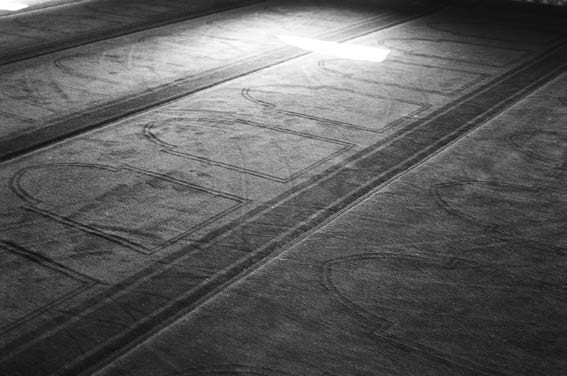
Over many years, Anja Manfredi has visited and photographed places of worship of Christianity, Judaism, Islam, Buddhism, Hinduism and other religions. In our exhibition she presents a summation which, in its concentration, also uses the built fabric of the gallery rooms as formal elements. It may be a happy coincidence that the building on whose first floor Galerie Charim is housed was, from 1781, the seat of the famous Viennese lodge “Zur wahren Eintracht”. Traces of this profane cult have survived in the stucco and in the arrangement of the rooms.
Anja Manfredi’s artistic work as a photographer is guided by an interest in gestures. In this she refers peripherally to the work of Aby Warburg, who coined the notions of pathos gestures and the picture atlas and made them productive for the study of art and culture. Manfredi extends this thinking: “I am interested in a thinking that becomes gesture and is at some point transferred into a materialisation.” For her, photography is just such a gesture, one which, in the case of our exhibition, turns its gaze on the material manifestations in sacred spaces and reifies them in photographs within an installation.
Just as we commonly speak of the emotion of farewell having become a gesture, various acts of diverse religious rites have become gestural actions. Similar to speech acts, gestures of blessing, for instance, accompanied by the appropriate words, give this act validity by performing it. A gesture thus also opens our exhibition: that of making the sign of the cross in the Catholic rite. It is at once a confession of faith, an acknowledgement of the dogma of the Trinity of FATHER, SON AND HOLY SPIRIT, and a sign of belonging. Ideally, the faithful first moisten their finger with holy water from a stoup, which can therefore be regarded as the reification of this gestural action become stone/architecture. Accordingly, the eros of a communally attested faith in a revelation which, handed down from generation to generation, was shaped into a cult, has produced corresponding spaces, objects, rituals and architectures that, in their material manifestations, authenticate the truth preserved in the mystery of faith.
In such cult spaces, built for the worship of God and the shared profession of faith, the artist’s open, interested gaze encounters a strict regime of looking. Through architectural constellations and the forms of behaviour required in such spaces, power is exercised over our bodies and perceptions. Profane everyday life is separated from the sacred by a threshold that functions, architecturally and mentally, as a transition. The artist experiences photography – as a gesture of appropriation, of declared interest, of selection and of the attribution of meaning – as a freedom which, however, in the course of her many years of engagement with sacred spaces, reveals a fundamental contradiction: only when shielded from our gaze does the numinous become present.
No people can be seen in the photographs on display. Their absence seems, as it were, to be staged, or rather it became a conscious decision in order to create a distinct context of perception and experience in the exhibition rooms. The photographs and the elements of the installation, such as the curtain, are lifted out of the documentary; they have a functional character. In keeping with the materialised gestures in sacred spaces, they open up a regime of looking and form constellations of photographs that create a context of meaning. Concentration and isolation quote the pagan sacralisation of art objects in a white cube, whose auratisation is broken by the manner of hanging. The curtain is a pictorial object that at the same time refers to veiling and unveiling in religious rites and has this function in the gallery too. It also screens off a small exhibition room which, with the photographs shown in it, thus actually becomes a place of contemplation.
Anja Manfredi’s decision in favour of analogue photography also plays into this, in that the technical processes, right through to developing in the darkroom, convey something of the fascination and wonder at an image coming into being through light. The past becomes present, and the images emerging in the developing trays make possible, and not only in a metaphorical sense, a command over time such as we would ascribe only to deities. In this respect, too, something of the numinous appears here, as a reflection of the places where Anja Manfredi took her photographs. The exhibition itself gathers many of these gestures, which show, at the art site of the gallery, that art is conveyed not in the objects but with and through them. Only attentive, comprehending contemplation allows meaning to emerge. Seen in this way, it takes community, the event and the works of art for silent gestures to speak to us in our gallery too.
We would also like to draw your attention to another exhibition by the artist: “Anja Manfredi, ATLAS” at the Bank Austria Kunstforum, tresor.