

Works
Artists
Exhibition Views


Press Release
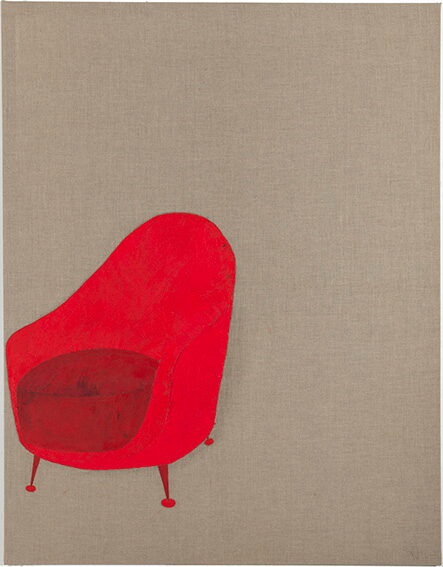
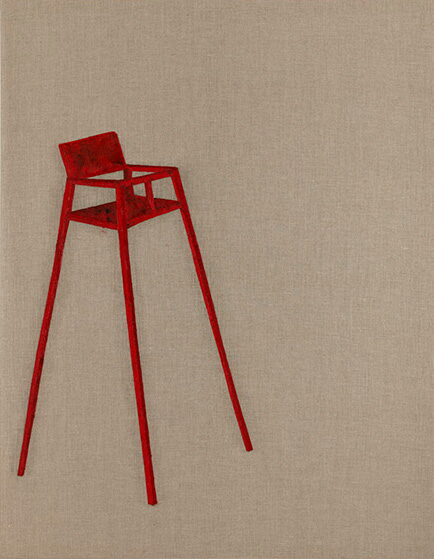
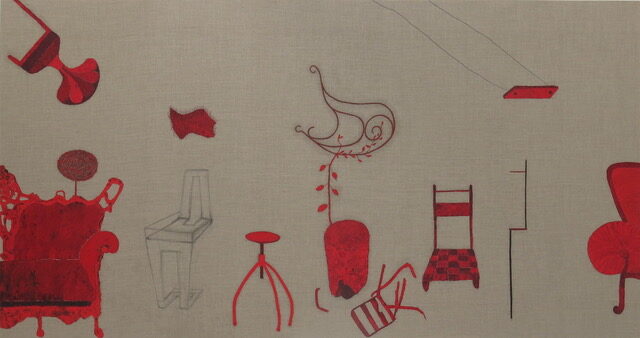
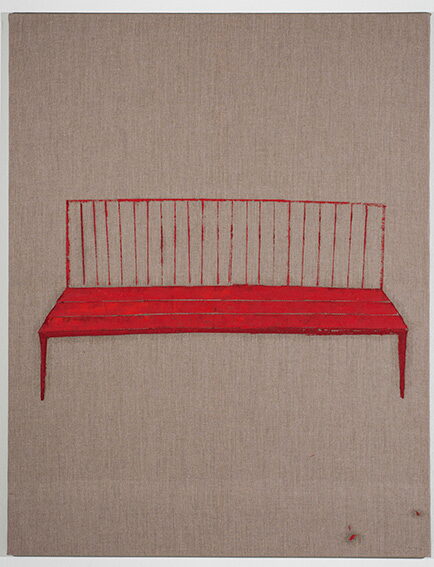
A good naturalistic portrait contains the character of the portrayed. I have been portraying people for more than thirty years – trying to catch their character – as chairs. Why would one represent personality with a painted chair? Of all the commodities we use, in terms of anatomy, a chair resembles us the most (head, legs, body) as it is formed for the shape of our body. We have a very intimate relationship with chairs as most of us spend more time on them than anywhere else. Chairs can represent a human being, for example in the apse of a church we often find a chair that is never used, wooden or carved out of stone – even during the service it remains empty. It is reserved for a bishop or an emperor – almost always empty – it represents and stands in for his/her status. The person is present even though physically not in the room.
Since 1989 some 130 chair portraits have come into existence. Red oil paint on canvas – in the formats 180 x 140 or 180 x 120 cm. Each image captures a personality who has/had an impact on my life and my artistic practice. Some of the characters portrayed are contemporaries, others might have passed away centuries ago – yet they talk to me through their literature, their art, their wisdom. Since the canvas is not treated with gesso, stains occur on the surface of the raw linen. Often the very thick layer of red oil paint extracts linseed oil that soaks the canvas around the image and stains it dark. The chair develops a shadow that appears as if it was surrounded by an aura, a process I cannot influence. Some chairs/humans have more of an aura, some less, some don’t seem to have any. All chairs appear awkwardly flat since there is no central perspective applied to the paintings. Most of them have only two legs instead of four, some are wrecks, others have missing parts, they all have handicaps. None of them are perfect.
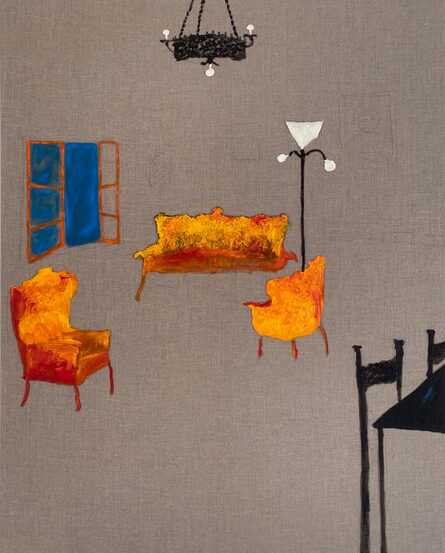
The big painting you are facing assembles a group of people I encountered in summer 2019 near Tarquinia, Tuscia/Lazio, where I have been living since I left Tokyo in 2011. An exception to the rule – both in dimension and as a portrayal of more than one person per canvas. The portrayed represent an exquisite society, many of them from powerful Italian, European and American clans. The swing on top represents myself, as I – wherever I go – prefer to swing by, instead of becoming part of something. On the opposite side you are facing individual portraits of friends in Italy, quasi counterparts to those depicted on the grand tableau.
Dear Cy,
Gaeta, February/March 2022
A spectacular coastline accompanies our illustrious little society, even with the eccentric Scotsman garishly dressed like a canary, and his noble wife gifted with a voice that must appall the pope she works for, it feels like being in Sicily. Sparse vegetation, emerald sea. Passing the snow-covered mountains rising steeply from the sea, we stop at the Emperor Tiberius’ colossal grotto. Carved into the rock at sea level it grants a somnambulistic view all the way to the end of the blue. Who knows if the rumours they whispered in Emperor Augustus’ ear about his hated stepson were not just propaganda – that his passions were not so different from his successors Nero’s and Caligula’s. The facilities inside the cave which were used for strolling and other amusements suggest there must have been something to the gossip though. Ridiculous how thousands of years later we puzzle over the love life of a mediocre Roman emperor. In the distance the view catches the Circeo, a small mountain range jutting into the sea, home of the sirens whose songs had failed Ulysses, who had had himself tied to the ship’s mast in order to resist their seduction. As a consequence the father of all gods ordered the ladies to drown themselves in the sea. One of them, Parthenope, was washed ashore far to the south, where, erected on her carcass, rose the city of Naples. Wherever one sets foot on this land, the soil is sorely tried by the gods, soaked in blood for millennia, steeped in history and mythology. Probably one of the reasons why you founded a studio here.
We arrive in Gaeta, an ancient town clinging to cliffs piercing the sea like a hook. Alessandro guides me through the numerous, high salas of the palazzo that served as your studio. It feels like I’ve arrived at the most beautiful place in the world. Nothing is too much, the quiet worn-out charm of the artist converted aristocrat: baroque furniture, Africana, baldachined beds, all styles mixed, valuables, showcases with antique artefacts and clay penises. Wherever one gazes one soul-consuming image follows another. One literally drowns in Bellezza – the infallibility of its beauty is intimidating. Yet hermetic, claustrophobic, the house has nothing to do with freedom. Fortified like the entire town, turned inward, shutting out the world, a fortress designed to protect from invaders. It does not communicate with the outside world. Its sparse openings won’t let air inside.
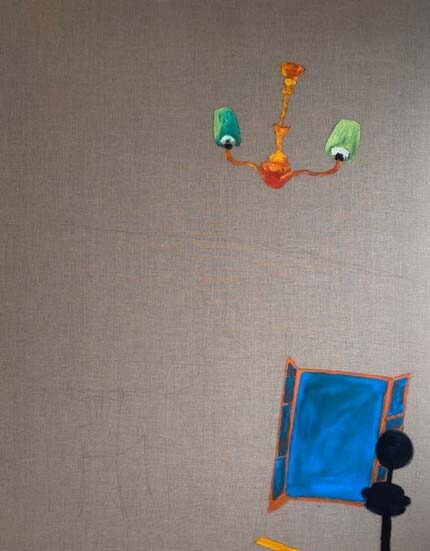
On the lower floor two small corner rooms, the ones with the most beautiful light. Cut into the wall two windows filled with the blue of the sea. Your colours spread out on folding tables, covered with faded British and Italian newspapers. On top of it your arsenal of paints. A wild mess, wooden panels, chalk, charcoal, empty canvases, cans full of brushes. Traces of you on empty canvases, traces of your painting on the walls, in the cracks between the white floor tiles. Do I need to bow? All appears like you just went around the corner for a coffee. Since then only family members came here, close friends like writers – yes, visual artists – no. And now I am here, the first painter since you passed away. What an honour. Alessandro says: ‘You can use these rooms for painting, shove my dad’s stuff aside, use it, throw it out, do with it what you want.’ ‘I beg your pardon?’ I reply. I should mess up your mess, use your colours, throw out your stuff, pair the splashes in the cracks between the big white tiles with mine? Sacrilege. Ale says: ‘Exorcisms of places and times are conducive. Take it as an oven … for yourself.’
Day by day I descended the stairs to your studio and stared at what you had left behind. Hesitatingly I moved my own colours in, started using your brushes, your papers, your canvases. I ended up with some 300 drawings, paintings and sculptures. On the last day of my stay I cleaned up what you had left behind, I ‘swept out’ according to your son’s wishes. I guess I have reconciled your spirit that did not want to go, as you’ve enjoyed life as much as I do, otherwise we wouldn’t have become artists.
A selection of works realised at Cy Twombly’s studio in Gaeta is on display in this room.
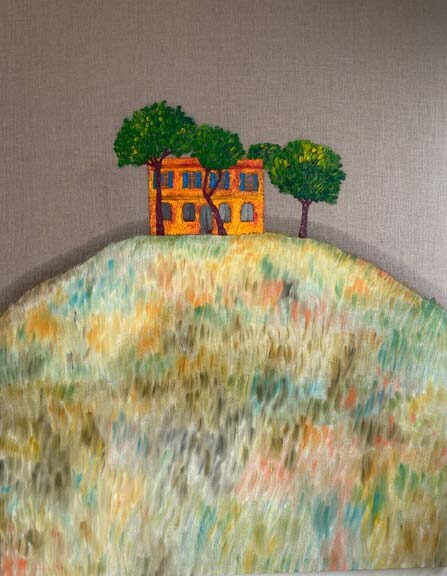
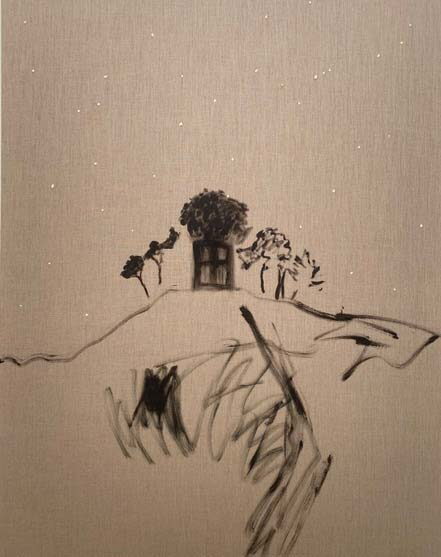
In the Maremma near the medieval town of Tarquinia, a soft hill, facing the Tyrrhenian Sea, sticks out of the wide plain. It embeds the sleep of an Etruscan king who, when laid to rest some 2500 years ago, demanded to face the sea forever. On top of his tomb hill a ragged Castelletto, surrounded by Aleppo pines, sticks out like a crown, like a ship stuck on a solidified wave. Rusty iron clamps hold it together. The wind whistles unbridled around this place, so that one can hear it all the way to Rome. Edgar Honetschläger moved into this house after living in Tokyo for some twenty years.
The house and the people of Etruria are the basis of the displayed paintings and drawings. It is also the place where Edgar’s utopian ecology project GoBugsGo (2018) started. There, around the hill, he shot his seventh feature film LE FORMICHE DI MIDA / MIDAS’ ANTS – with the help of dryads, donkeys and Hegelian farmers. The exhibition reveals the interpenetration of media used by the artist and filmmaker. A poetic introspection, mirror of the soul of a magic place.