

Artists
Exhibition Views
Press Release
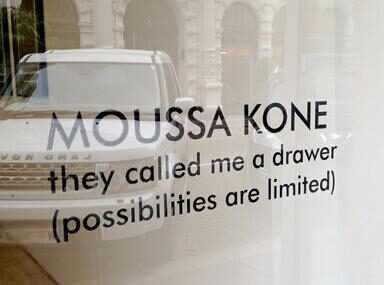
“they called me a drawer” can be heard and visualised in manifold ways. The play on “draw”, “drawer” and “drawing” was not lost on Moussa Kone’s new-won colleagues in New York during his ISCP stipend when they introduced him to their fellow artist friends as “the drawer”. Melting the theme of his drawings with the act of his craftsmanship provided Moussa Kone with a new identity, one that condensed in one word his works and the act of creating them. With this new title, “the drawer”, Kone began to experiment with the limited and yet unlimited possibilities such a metaphor entails. In contrast to the saying that “one can put all in one box” (man kann alles in eine Schublade stecken), Kone went ahead and explored the outer and inner lives of a series of drawers, leaving the spectator puzzled at how to unravel the meanings and mysteries hidden behind and inside these finely executed chests of drawers. For the usual orderly life of a drawer, this intense and detailed focus upon its interiors and exteriors poses a new challenge, drawing the viewer into a world of order and chaos, illusion and disillusionment.
Are the spectators to be as overwhelmed as the little comic-strip figure, floating from one drawer to the other, holding onto two handles and balancing one foot on a single handle? Are we to identify with him and think of life as a similar balancing act where we are overwhelmed by the immensity of a bureaucracy hiding behind rows of faceless drawers? What is where? How do these drawers hang together and what do they contain? The juxtaposition of the small figure and the huge filing cabinet evokes many tales of ardent struggles where individuals’ lives are crushed by the enormity of an anonymous, devastating bureaucratic power. A system that is supposed to create order, that files documents, papers and records away, looms large in Moussa Kone’s drawings, leaving the lonely man feeling powerless and overwhelmed as he faces a dark filing system that may contain secret information about his own life or those of others. The TV series Cold Case comes to mind, where a young woman detective solves older crimes that have never been brought to justice. Once she has found the culprits and put the present back together with the past, the file can be closed and locked up for good. Stasi file systems, the Nazis’ penchant for keeping records on all those millions they killed, come to mind as we are contemplating the many files, possibly containing records of past lives, unsolved and clandestine crimes.
The theme of the “drawer” takes yet another turn as we search for psychoanalytic meanings of the subject of “drawers” or “boxes”. Throughout Freud’s works, we come across two principal meanings with which drawers tend to be associated: 1) a chest of drawers is equated with the torso of a woman, as Salvador Dalí already depicted it in both painting and sculpture with The City of Drawers and The Woman with Drawers. 2) The “empty” drawer, on the other hand, is a symbol of a woman’s uterus, a space that produces life but also forebodes death. Thus, by extension, the drawer/box also acquires the meaning of the final box, the casket in which we place the dead body. In The Interpretation of Dreams (1900), Freud writes that “the heart will be represented by hollow boxes or baskets” (p. 86); “Boxes, cases, chests, cupboards and ovens represent the uterus” (p. 354); “A man had a dream of his brother being in a Kasten [box]. In the course of interpretation, the Kasten was replaced by a Schrank [cupboard – also used abstractly for ‘barrier’, restriction]. The dream-thought had been to the effect that his brother ought to restrict himself [sich einschränken] – instead of the dreamer doing so.” (p. 407) In Freud’s famous case history of Dora, the symbolism of the box/Schachtel takes centre stage as one of her dreams reveals the close unconscious link between a box and a woman as well as the tie between a key and a man. Freud (1905) writes: “‘Where is the key?’ seems to me to be the masculine counterpart to the question ‘Where is the box?’ They are therefore questions referring to the genitals.” (p. 97) In a later, less known essay, The Theme of the Three Caskets (1913), Freud discusses The Merchant of Venice and King Lear and arrives at the conclusion that when a man has to choose between three caskets, as the suitors are obliged to do as they woo Portia, the suitors are not really choosing between three caskets but between three women. “If what we were concerned with were a dream, it would occur to us at once that caskets are also women, symbols of what is essential in woman, and therefore of a woman herself – like coffers, boxes, cases, baskets, and so on.” (1913, p. 292)
Moussa Kone, who had hoped to establish a new order in his life as he moved to New York, inadvertently returned to the very subject matter that had dominated his previous works, i.e. the naked body, male and female sexuality and the power of the erotic.
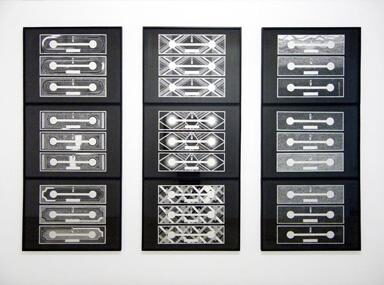
Turning our view back to Moussa Kone’s second drawing, he juxtaposes three sets of drawers side by side, in which the drawers take on a life of their own, resembling faces, with the two knobs standing in for two eyes, empty labels standing in for the mouth, and the lock standing in for the nose, which again acts as an upward displacement for women’s genitals. In this second drawing, the chest of drawers loses its anonymous identity and obtains a face of its own, distinct and other from the rest of the drawers. One is invited to play with the different graphics, comparing the criss-cross sections with the more tone-in-tone grey drawers. One’s mind wanders between the different designs and empty labels which do not disclose the inner contents of each drawer. However, one structural element remains the same throughout the variety of these drawers, and that is the number three. No matter how differentiated these drawers’ lives come to be, they are always held in an encasement of three. What significance could this number three entail?
In The Theme of the Three Caskets, Freud contends that “the third” has a powerful symbolic stance; whether it is King Lear choosing between three daughters to divide the fortunes of his kingdom, or Paris choosing between three goddesses, or Cinderella being the preferred third to her two older, more obnoxious sisters, “the third”, Freud writes, “is the most excellent one”, yet also most often the quiet and unassuming one. In one stroke, Freud equates the “excellent third woman” with dumbness, silence and concealment and eventually death, as “Hiding and being unfindable – a thing which confronts the prince in the fairy tale of Cinderella three times – is another unmistakable symbol of death in dreams.” (1913, p. 295) “But”, Freud continues, “if the third of the sisters is the Goddess of Death, the sisters are known to us. They are the Fates, the Moerae, the Parcae or the Norns, the third of whom is called Atropos, the inexorable.” (p. 296) These Moerae, also known as Horae, were known as spinners; from being the “divine representatives of the Seasons”, they became the goddesses of Fate, spinning and presiding over the fate of each human being. Clotho, the eldest, spun the thread of life, Lachesis, “the allotter”, measured the thread of life, and Atropos, the “inexorable”, was the one to cut the thread of life. “She chose the manner of each person’s death, and when their time was come, she cut their life-thread with her abhorred shears.”
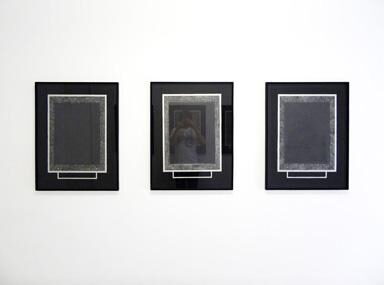
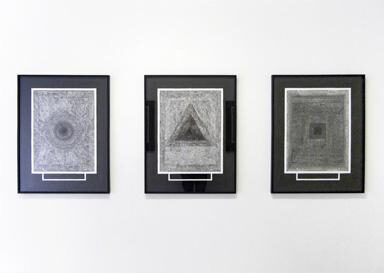
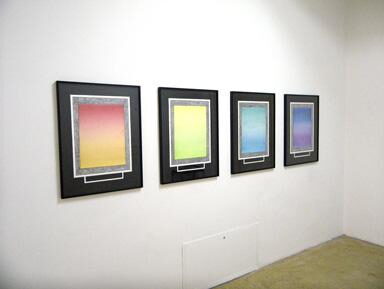
What lives and destinies are spun through Moussa Kone’s chests of drawers, what signifiers and signifieds are hidden from us as we are also allowed to peek inside Kone’s finely sketched drawers? As we pull them open, we are surprised not to be confronted with written files or dark secrets but with circles, squares and triangles as well as light-coloured airbrushed aquarelles spanning the colours of the rainbow. Do those fundamental structures and colours constitute the inner lives of drawers, or are they the back- and underground for what we, the viewers, placed inside of them? Were our dark forebodings of secret, unresolved destinies merely a figment of our imagination, or did Moussa Kone’s drawers just provide a potent enough symbol to draw us in, and then drew a curtain over the disorder that may lie behind? From black, white and grey to soft lilac colours, from lists, categories and orders to a multiplicity of beings, from eros to thanatos, Moussa Kone’s seemingly simple drawers evoke a world of phantasy and imagination for which he, in the final drawing, also provides a set of four keys, offering each viewer the opportunity of unlocking the drawers of their own imaginative choice.
And there is no draw-back to that.
Text: Jeanne Wolff-Bernstein
Moussa Kone’s series “They called me a drawer (possibilities are limited)” explores the properties and possibilities of the medium of drawing; it is the draughtsman’s reflection on himself and his means of expression.
The motif of the series has been chosen accordingly and is explained in the title, a deliberate play on words between the English word for a sliding storage box and the not quite correct “drawer” for draughtsman. The drawers in the series, all drawn according to the same repeating pattern, stand for ordering, sorting and categorising – activities that also underlie drawing. Moussa Kone seeks the characteristics and origins of drawing in an act of ordering, collecting, reflection and (self-)contemplation. Drawing, at least in its origins, aimed to work out a subject systematically and is a logical, rational, ordering activity. The line is an abstract sign, and it is only through a cognitive act that a motif is assembled from drawn lines.
It is no coincidence that this media-reflexive series uses a motif based on the basic forms of square, circle and triangle, which bring an interplay between abstraction and representation to the sheets. The same pattern recurs on every sheet; emphatic flatness and two-dimensionality alternate with rigid, classical central perspective in the drawers seen from above.
Moussa Kone is particularly interested here in drawing as an abstract system of signs. Asked about this, he points to a parallel between drawing and writing, for the work on the series follows predetermined structures: the blank sheet is filled line by line according to a precise theoretical plan – a choreography, so to speak – with the classic pen nib as the tool. This structure is varied hardly or not at all and is transferred like a template from sheet to sheet.
Writing was originally developed for reasons of administration and economy, rather than to pass on myths or record “poetic” texts. In the early days of writing, information was presented as lists and conveyed through abstract signs. Creative expression was still severely restricted by the given order; the organic was subordinated to the systematic and the logical.
In this series, Moussa Kone examines drawing as an exercise in order, collection and logos, which is necessary in order to work out an object from an abstract system of signs. At the same time, he raises the question of the possibilities of creative expression within this system, for instance with the opulent, gestural, “emotional” lines of the hatched areas.
Thematically, he also links up here, to a certain extent, with earlier series. In the series en pointe (2009), for example, he engaged with ballet when he had access to a private dance library. Reflection on his own medium – drawing, the act of drawing – was already inherent in the content of that series as well. Just as dancers practise an art based on the disciplining of the body, drawing is a disciplining of the hand. Dancers use a trained, standardised vocabulary as the foundation of their art, and only on this basis does poetic expression build. Moussa Kone pursues the question of how creativity springs from these very structures on the one hand, and, on the other, of the possibilities of bringing the emotional and poetic into these given structures. Creativity is examined as an emancipatory act, an act of self-determination and self-responsibility.
Text: Milena Dimitrova