

Artists
Exhibition Views
Press Release
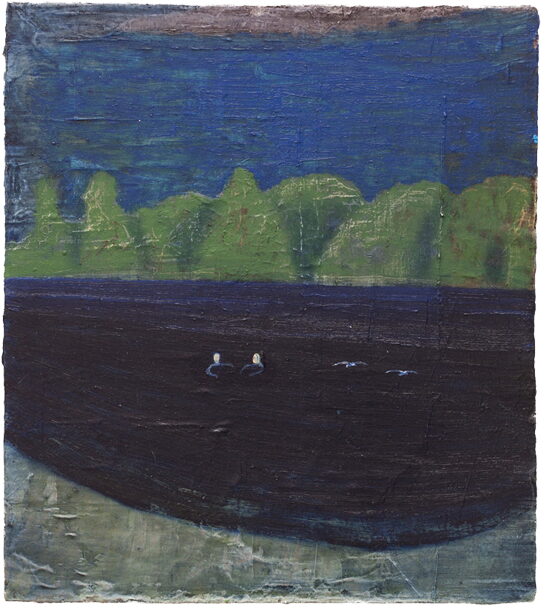
Often it is fleeting impressions, taken straight from everyday life, that – much like the residues of the day – live on in Eiko Gröschl’s fantasies. A glance from a passing tram, catching a woman just about to step into a puddle, would be such a seed of crystallisation that remains as an inspiration for a picture. The artistic results are small-format paintings that capture such a moment. One can imagine stories around them, inner narratives that elaborate on what happened shortly before, and perhaps also what will happen shortly after. These will be stories in which something uncanny resonates – premonitions, vague notions – and often a sense of the abysmal will congeal into a shadow that accompanies many of the figures in the pictures.
Indeed, it is also an indefinite feeling that makes us take notice in everyday situations. A multiplicity of meaning seems to be present in these momentary impressions. And because the occasions are banal, ordinary, somehow insignificant, a kind of unease grows stronger. Eiko Gröschl traces this unease and tries to make it visible, in order to capture in a picture the vagueness that presses forward and at the same time eludes us. Painting allows contradictory qualities to remain suspended side by side; painting even makes this possible. Photography, for instance, would tempt us too strongly to identify what is depicted as a reflection of reality. Painting creates the distance needed to regard something as a made image, while at the same time being touched, addressed, perhaps also unsettled and frightened by what becomes visible.
The exhibition at Schleifmühlgasse shows not just individual pictures; it shows more, and so it becomes apparent that some of the motifs are repeated. The repetitions and recurring shadows bring to mind a relentlessly distant sun that witnesses these scenes, in which something presses forward that wants to be worked through and reworked in repetition. The exhibition also shows that different painterly methods are used to make visible the uncertain that has congealed into colour. Airy paintings, in which the suspended particles of the pigments take shape, clothe objects and people in colour. Detached in this way from the painted ground of the canvas, they preserve the fleeting. Next to them, other pictures resemble illustrations. With their opaque application of paint, they recall the picture books in which the world is explained to children through gestures that assign meaning. In this way children learn to name the objects and people in the world, and they also grant reality to the pictures. These are themselves taken to be “real”, so that, according to a childlike understanding, the objects and figures in the pictures can also act, feel and move between worlds.
In adulthood, many childlike experiences lie beyond the horizon that time, setting its limits, draws for our perception. Often only in fleeting impressions – in situations where, for example, tiredness opens up a sensibility that the dominant mode of our reason suppresses – are we overcome by a feeling of the uncanny. At times in a way that can drive us out of our minds. It seems evident that there is something there, something more than what is dressed in the everyday and the banal. And so the repetitions lead us on the trail of the uncanny in Eiko Gröschl’s pictures. Thinking with Freud, something becomes uncanny when a surmounted childlike belief in reality later seems to take effect in concrete everyday life – when remnants of this understanding of the world have survived and become linked to actual events. Often it is also a return to times when wishing still helped, a wishing that, alongside hope, lets a premonition of horror take root. The wondrous, too, which delights unexpectedly in Eiko Gröschl’s pictures, nourishes the shadow of doubt behind the averted side of this radiant artistic pleasure. This, too, we want to enjoy. That is what art can do.