

Works
Artists
Exhibition Views
Press Release
We are so familiar with photographs as images made of LIGHT that this fact has become little more than a commonplace, and the source of all seeing, the sun, has moved entirely out of the centre. In his third solo exhibition at our gallery, Markus Krottendorfer puts it back at the centre! He stages its radiance and captures its rays in order to show the technical and architectural apparatus that was built in the Arizona desert in the 1960s as an observatory for studying the sun.
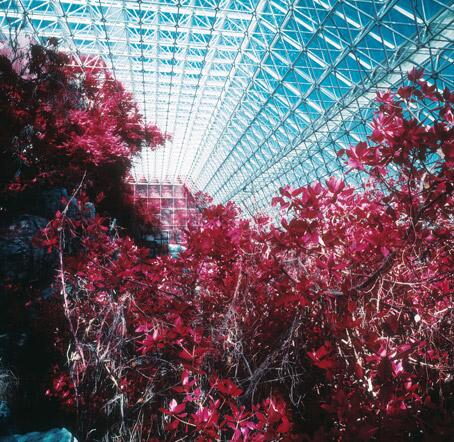
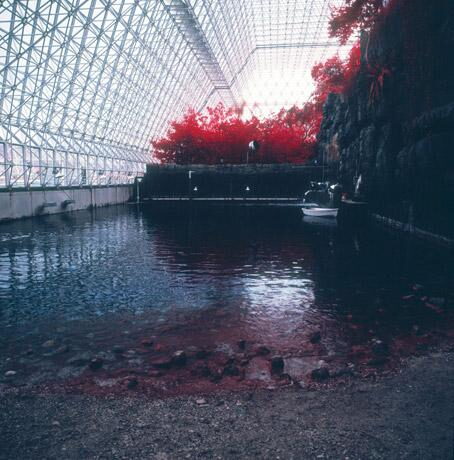
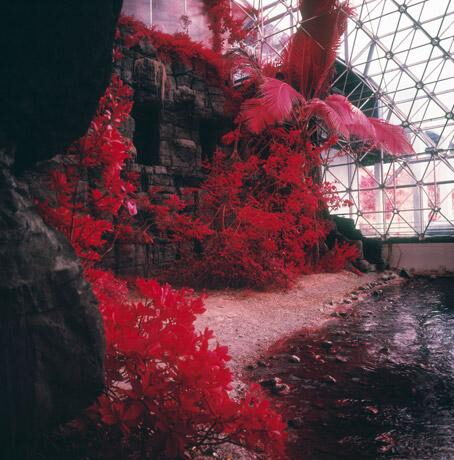
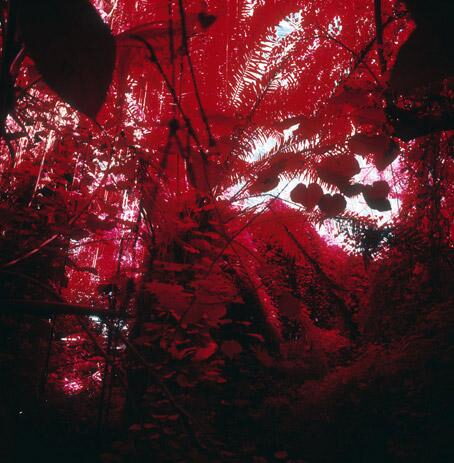
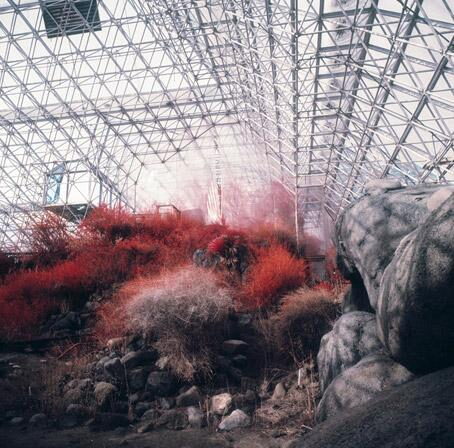
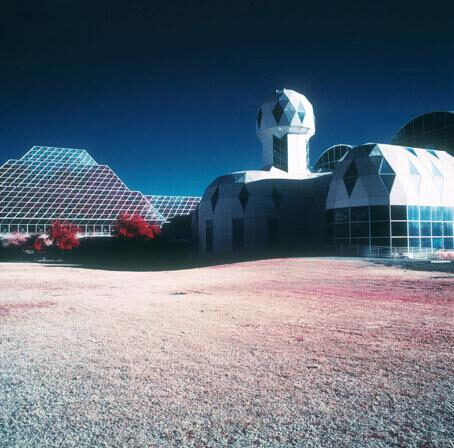
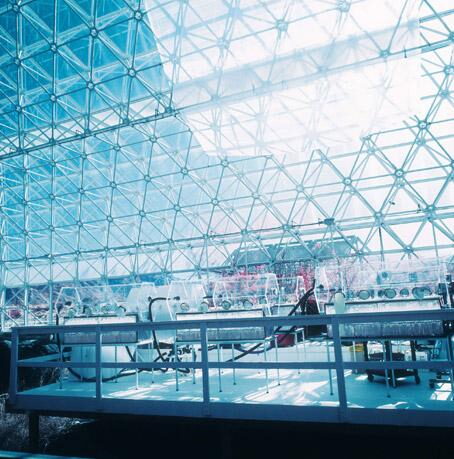
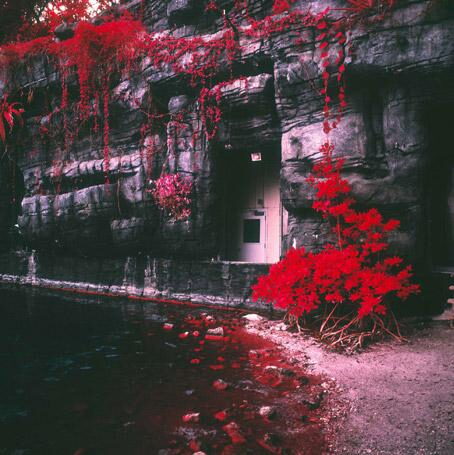
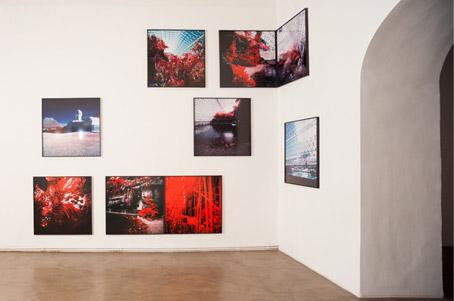
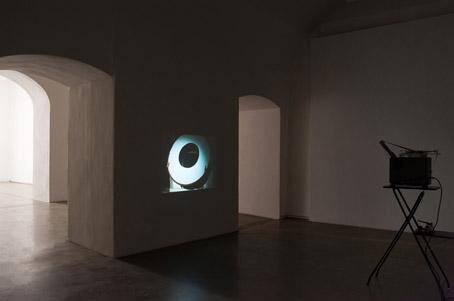
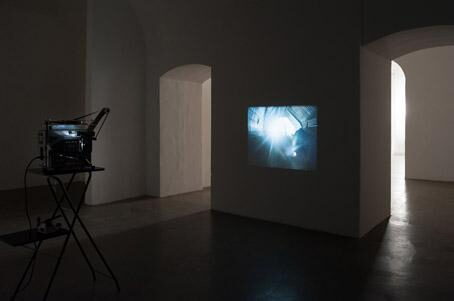
He shot his 16mm film “Mc-Math Pierce Solar Telescope” inside the tube of that solar telescope in Arizona. Images from various science-fiction films involuntarily come to mind: spaceship constructions and technically designed habitats for people travelling through empty space towards destinations whose distant, longed-for goal is a habitable Earth. Another part of the exhibition, Biosphere II, shows in a sequence of photographs just such a survival world, which here on this Earth, in the middle of the scorching sun and surrounded by an inhospitable desert landscape, tests life in a self-sufficient biosphere; Biosphere II serves as a model for various settlements which, inspired by the American colonist spirit, are meant to create a home on distant planets.
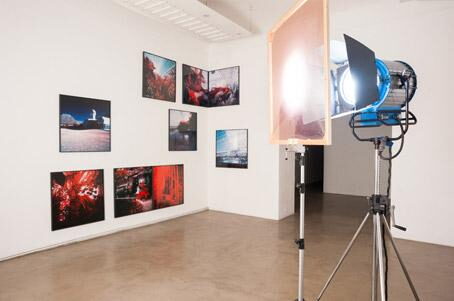
Markus Krottendorfer stages these references and connotations by darkening, shading and lighting the rooms of the gallery and using them as a sequence of spaces directly connected with the times of day. From the darkness divided by the beam of a projector, from inside an observation tube, we look at mirrors that redirect sunlight onto detectors and observation instruments inside a mountain cave. This light, captured on film, is now cast back by the projector itself and illuminates the adjoining rooms of the gallery. Shaded and empty, they become formal elements of a world sealed off from outside light, whose purpose is the study of the sun, the regularity of its orbit and its moving surface, and the measurement of the radiation spectra of electromagnetic waves.
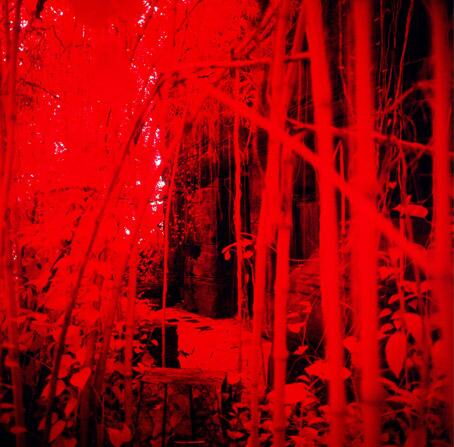
Sunlight is more than just the light visible to us. The technical medium of photography makes it possible to extend the spectrum of what we see with the naked eye and to show the world in a different light – especially a world that is meant to artificially recreate a living biotope. Markus Krottendorfer photographed the building complex that houses Biosphere II with infrared film. The strange-looking views of glass structures, test tubes, plants and recreations of nature really do seem to show an alien planet with humanoid settlement. Perhaps it is also just a sentimental look back from a distant future at the primal scene that shows the beginning. These icons of departure are now lit in a dark cave by an oversized artificial sun. This is the second light source in the exhibition, a large floodlight of the kind used on film sets. The utopia of setting out for other worlds, which seemed real only a few decades ago, is something we now experience, so it seems, only in post-apocalyptic cinematic epics.